01
State is not behavior.
A snapshot can be clean at 9 AM and the system can still be on a path to compromise by noon.
Building security for an autonomous world
Beyond Posture, by Himanshu Tiwari, explores how security must change as AI agents, automation, and control planes reshape what systems can do. The focus is trajectory governance: shaping which sequences of action are possible, not only assessing the current state.
Available in hardcover, paperback, and Kindle.
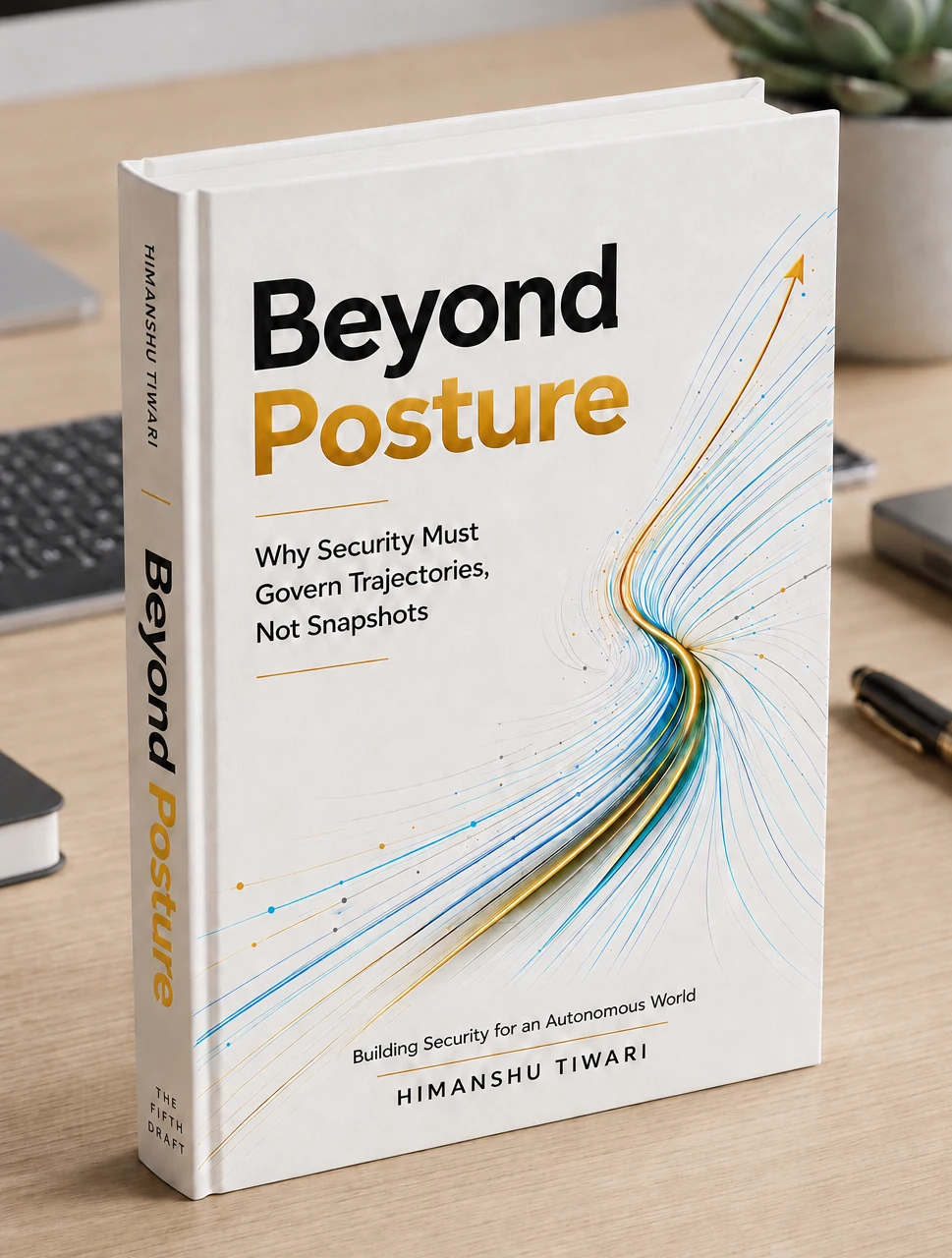
Posture tells you where you are. Trajectory tells you where you are going.
Part I · The diagnosis
Modern risk is not best explained by a static state. It forms through sequence, accumulation, authority, and the disappearance of the human pause.
A snapshot can be clean at 9 AM and the system can still be on a path to compromise by noon.
Permissions grow one diff at a time. No single change is critical. That is the problem.
The unwritten human buffer that absorbed structural weakness for 20 years is no longer in the loop.
A snapshot can be accurate and still mislead.
“Watching the wrong unit more often doesn’t make it the right unit to watch.”
Chapter 2 · The Snapshot FallacyA progression of questions
This is the book’s progression of security questions - not an implementation sequence. Each question moves the unit of reasoning farther upstream.
Where are we?
State describes what exists.
How did we get here?
Behavior explains how the system moved.
What decisions brought us here?
Decisions explain which path was chosen.
What futures are possible from here?
Trajectory governance determines which paths can be chosen at all.
Trajectory governance is the practice of shaping which sequences of action are possible within a system.Beyond Posture
The set of meaningful actions, transitions, and future states available to a system given its authority, workflows, interfaces, and trust relationships.
A control plane isn’t just where a system is administered. It is where authority is authored.
Unsafe trajectories are made unreachable by design through architecture, interfaces, authority boundaries, and valid transitions.
The system does not merely detect or reject the bad move. It does not offer the bad move as a normal option.
The unsafe sequence is not detected faster. It is absent.
Governance before autonomy
It reveals whether safe patterns have already propagated - and whether broad authority, inherited trust, and off-road workflows have already become normal.
Follows a script. Its path is fixed in advance and can be reviewed line by line.
Follows an objective. It interprets, adapts, selects, and navigates toward an outcome.
Security moves from verifying execution to governing motion and decision authority.
Security leadership
The next decade of security leadership belongs to builders.
Making the transition
How to get from where you are to where the model points - without stopping the business.
Make the trajectory-governed path cheaper than the legacy path. Platform investment is the security investment.
Measure decision space, not just inventory. DAR coverage. MTTA. Trust Inflation trend.
Mark the legacy path for end-of-life. Date-stamped. Communicated. Believed.
Remove the legacy path. Constraint becomes structural. The unsafe trajectory is no longer reachable.
Hybrid is the strategy. Sovereignty is the destination. Speed is the dividend.
The book behind the framework
Why Security Must Govern Trajectories, Not Snapshots
A practical argument for moving security from static posture and downstream correction toward decision space, structural constraints, and governed authority.
Available in hardcover, paperback, and Kindle.
“A visionary framework of trajectory governance ... enabling innovation that is both deeply personalized and powerfully effective at enterprise scale.”
Miguel E. LakkisPresident, Bitbug, Inc. · 3x CISO
“Beyond Posture opens the discussion on a new way of thinking about cybersecurity risk by focusing on the trajectories and environmental conditions that ultimately lead to material exposure.”
Scott Barronton3x CISO · Diebold Nixdorf, Finastra, D+H
Begin with one deletion
Pick one workflow. Delete one unsafe future. Then make that deletion durable.
Trajectory governance becomes real when a known unsafe path is no longer available through normal work.
Beyond the book
Essays by Himanshu Tiwari on cybersecurity, AI, product strategy, and leadership.
Individually reasonable decisions can combine into outcomes no one intended. Through product commitments, report sharing, and agent delegation, this essay explores how to preserve agreed boundaries while leaving people and agents room to decide how the work gets done.
Read on Medium (opens in a new tab)Delegating remediation adds execution capacity—and authority. How do we let providers and agents fix problems without letting them expand their own boundaries?
Start with the outcome, then bring together the people who control the decisions, capacity, and dependencies needed to deliver it. Nothing essential missing. Nothing redundant.
AI gives product managers time back. The opportunity is to deepen customer understanding, product judgment, and market insight—not simply produce more artifacts.